
Driving in Aruba: Road Rules, Roundabouts and Local Tips

Aruba is 30 kilometers long and 6 kilometers wide. You can cross it from the north coast to the south point in about 40 minutes, and the roads that matter to visitors are paved, well marked and rarely busy. Most people who worry about driving in Aruba before they arrive have forgotten about it by the second day.
That said, a few things work differently here than they do in Florida, Ontario or Amsterdam. Roundabouts instead of traffic lights. Kilometers instead of miles. An attendant who pumps your gas. None of it is hard, but knowing it before you turn the key saves you the awkward first hour.
Driving in Aruba: what the roads are actually like
Aruba drives on the right, the same as the US, Canada and continental Europe. You overtake on the left. Road signs use kilometers per hour, so the numbers look higher than you are used to while the actual speeds are lower.
The island runs on a simple road skeleton. L.G. Smith Boulevard is the main artery, connecting Queen Beatrix International Airport to Oranjestad and continuing north along the coast toward Eagle Beach and Palm Beach. J.E. Irausquin Boulevard runs parallel to it through the hotel strip. Almost everything a visitor wants to reach hangs off one of those two roads or a short spur from them.
Surfaces are good across the tourist half of the island. The exception is the northeast: the roads inside and around Arikok National Park turn to rough unpaved track, and rental agreements usually exclude them for standard cars. More on that further down.
Traffic volume is low by mainland standards. Rush hour around Oranjestad between 7:30 and 8:30 in the morning is the only time you will sit still, and even then you are counting minutes rather than half hours. Cruise ship days add congestion downtown, since up to four ships can be berthed at once.
Aruba road rules every visitor should know
The Aruba Tourism Authority publishes the general rules on its official driving in Aruba page. The core set is short.
| Rule | What applies in Aruba |
|---|---|
| Driving side | Right; overtake on the left |
| Speed, urban areas | 30 km/h (about 19 mph) |
| Speed, out of town | 60 km/h (about 37 mph) |
| Speed, faster roads | 80 km/h (about 50 mph) |
| Roundabouts | Traffic already on the circle has right of way |
| Unmarked crossroads | Traffic from the right has right of way |
| Turning left | Oncoming traffic goes first |
| Driver's license | Your home license is valid; no international permit needed |
The urban limit of 30 km/h catches a lot of visitors out. It feels slow, especially on a wide, empty stretch of J.E. Irausquin Boulevard at nine in the evening. Posted signs override the general rule, so watch for them: sections of L.G. Smith Boulevard are signed at 80.
The right-of-way rule at unmarked intersections is the one North American drivers most often get wrong. In residential neighborhoods around Noord and Santa Cruz you will find junctions with no stop sign and no markings at all. The car approaching from your right goes first. If you are the one on the right, the other driver is expecting you to go, and hesitating creates more confusion than proceeding.
Seat belts are required, and Aruba's legal blood alcohol limit sits at 0.05 percent, stricter than the 0.08 in most US states. Two beers at a beach bar can put an average adult over it. The island has plenty of taxis and the hotel strip is walkable in the evening.
Local driving habits worth knowing
Drivers in Aruba are relaxed and generally courteous. Someone will flash their lights to let you merge. Horns are used sparingly and rarely aggressively. What does surprise visitors is the tendency for a driver ahead to simply stop in the road to talk to someone on the sidewalk or drop off a passenger. Leave following distance and expect the unexpected pause.
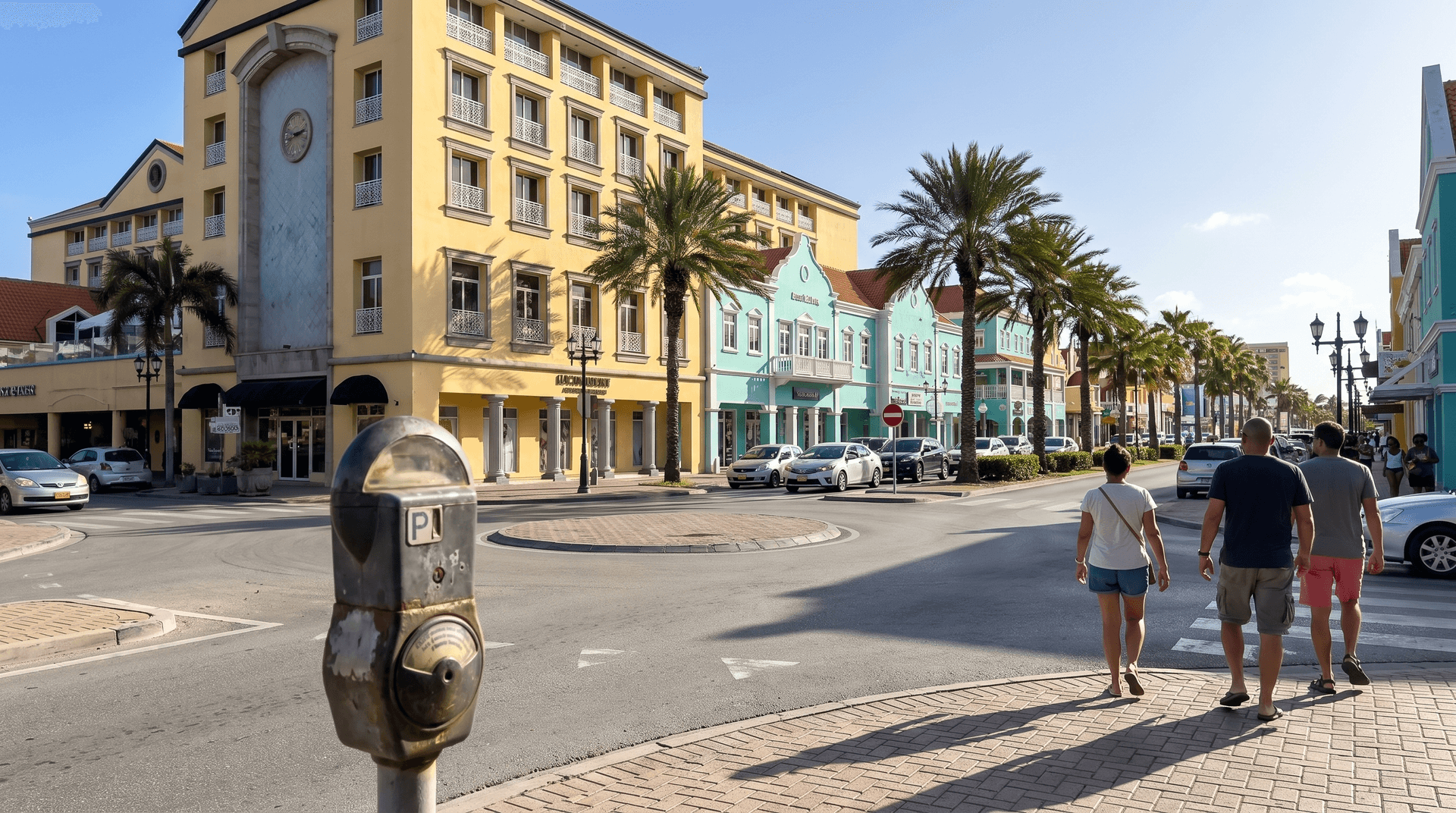
Pedestrians in Oranjestad cross where it suits them. In the shopping streets around Caya G.F. Betico Croes, drive at walking pace and assume someone will step out from between parked cars.
Roundabouts: the part that trips people up
Aruba uses roundabouts where many countries would install traffic lights. There are dozens of them, and once you accept how they work they move traffic faster than any signal.
The rule is simple: cars already on the roundabout have right of way. Approach slowly, look left, wait for a gap, enter, then signal right just before the exit you want. Do not stop once you are inside the circle unless the car in front of you has stopped.
Three things help. First, know your exit before you enter, because reading signs mid-circle while watching for traffic is how people end up going around twice. Going around twice is fine, by the way, and nobody will mind. Second, on the two-lane roundabouts near the airport and Oranjestad, stay in the outer lane if you are taking the first or second exit and the inner lane for anything further round. Third, watch the driver behind you: local drivers judge gaps tighter than most visitors do and may expect you to move sooner than you feel comfortable.
The roundabout at the airport exit is the busiest on the island and the first one most visitors meet, roughly four minutes after picking up their rental car. Take a breath before you leave the lot.
Gas stations, fuel and what it costs
Fuel prices in Aruba are set by the government and are the same at every station on the island. There is no cheaper place to fill up, so ignore the instinct to shop around.
At most stations you stay in the car and an attendant pumps for you. Tell them how much you want, in florins or dollars, or ask for a full tank. If you come across a self-service pump, you pay first and then fill. Both florins and US dollars are accepted everywhere, along with major credit cards.
Stations cluster around Oranjestad, Noord and along L.G. Smith Boulevard. They thin out toward San Nicolas and the south point, and there is nothing at all near the California Lighthouse or inside Arikok. Fill up before you head to Baby Beach or the north point, the same advice locals give each other.
A compact rental car burns very little here. The whole island is 30 kilometers long, and a week of beach hopping and one full island loop rarely takes more than one and a half tanks.
Parking in Aruba
Parking is free at nearly every beach and attraction, including Eagle Beach, Palm Beach, Arashi and Baby Beach. Oranjestad is the exception: the city has parking meters and you need to check the signage before walking away.
Three parking prohibitions are worth memorizing, since they are enforced. No parking alongside a yellow curb line. No parking on a bridge. No parking on a road with a continuous center line. Our complete Aruba parking guide covers the Oranjestad meters, cruise port days and where the free lots are.
At the popular beaches, arriving before ten in the morning gets you a shaded spot under a divi-divi tree. After eleven you park in full sun and return to a car that has been baking for four hours. Crack the windows a centimeter and use a sunshade if the rental comes with one.
Which roads to drive and which to skip
The paved network covers everything most visitors want.
| Destination | Drive time from Palm Beach | Road condition |
|---|---|---|
| Eagle Beach | 5 min | Paved, easy |
| Boca Catalina | 10 min | Paved, easy |
| Druif Beach | 10 min | Paved, easy |
| Oranjestad | 10–15 min | Paved, meters downtown |
| Arashi Beach and California Lighthouse | 15 min | Paved to the lighthouse parking area |
| Mangel Halto | 25 min | Paved, narrow final approach |
| Baby Beach and San Nicolas | 30–35 min | Paved, easy |
The northeast coast is a different proposition. Boca Prins and Dos Playa look spectacular in photographs, and the water there will drown you: heavy surf, strong currents and no swimming. Reaching them means unpaved track that a standard rental is not insured for. The same applies to most of the interior of Arikok National Park.
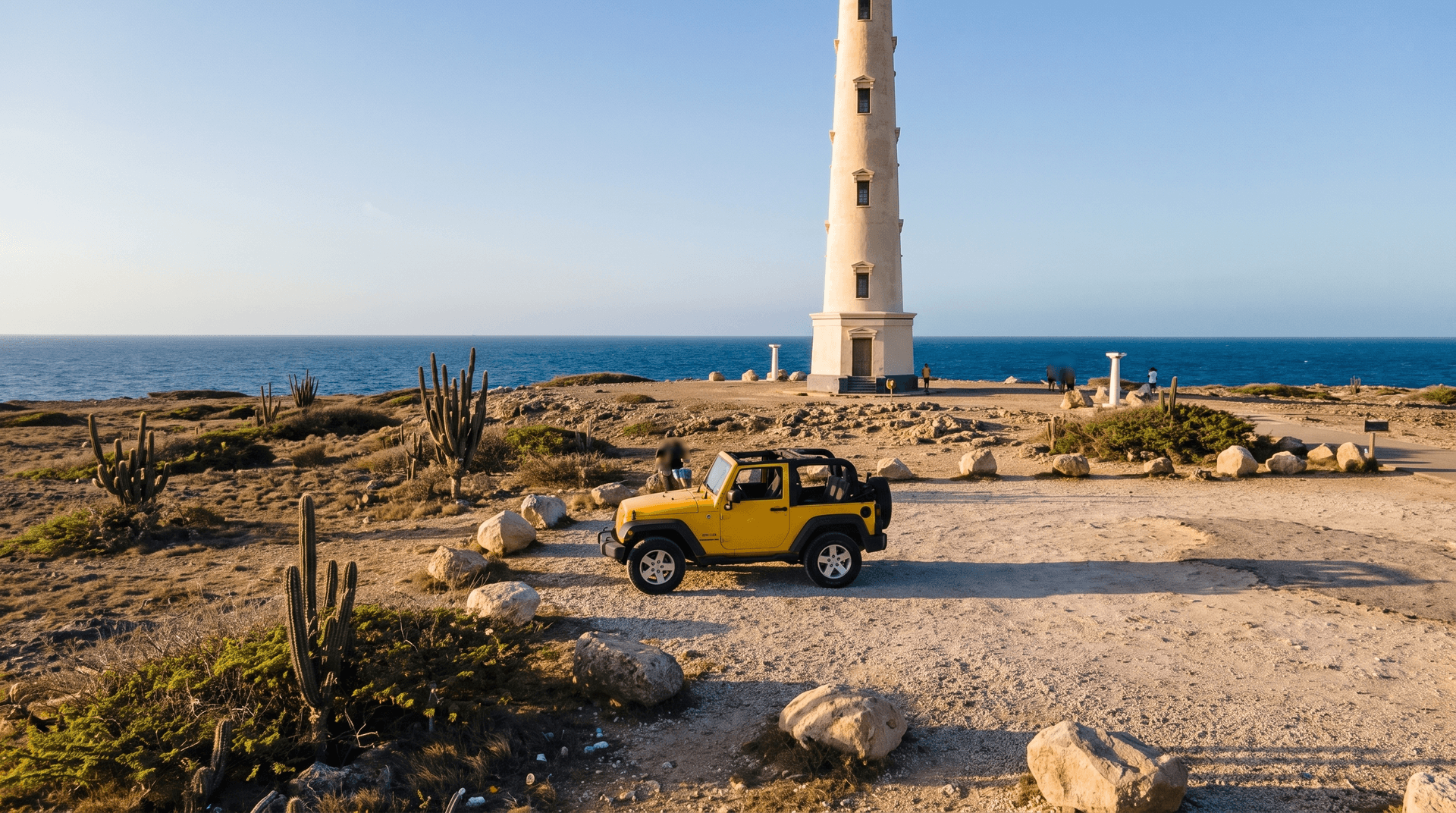
If that terrain is what you came for, rent the right vehicle rather than risking a compact. A high-clearance 4x4 handles it comfortably, and we cover the route, the entrance fee and the practicalities in our Arikok National Park 4x4 guide. Jeeps are widely available from local suppliers on our Aruba jeep rental page.
Choosing a car for Aruba roads
Match the car to the roads you will actually use. Roughly nine out of ten visitors never leave pavement, and for them a compact is the better buy: cheaper, easier to park in Oranjestad, and perfectly capable on every road between the airport and Baby Beach.
| Category | Local supplier, from (per day) | International chain at the airport counter, from (per day) |
|---|---|---|
| Economy | $25–35 | $50–70 |
| Compact | $30–40 | $55–75 |
| Intermediate/Midsize | $35–50 | $60–85 |
| SUV / Jeep | $45–75 | $80–120 |
| Minivan / 7+ seats | $60–90 | $100–150 |
These are indicative starting rates from local suppliers in low to shoulder season. Peak periods around Christmas, New Year and Carnival run 30 to 60 percent higher.
Air conditioning is the one specification worth checking rather than assuming. Aruba sits outside the hurricane belt in a dry, sunny climate with constant trade winds, and a car parked at Baby Beach for three hours becomes an oven. Every listing on TropicDrive shows the specification up front.
"Easy booking process and great customer service. Will definitely use TropicDrive again." — Michael R.
Booking a car you can trust on these roads
Aruba has a large number of local rental companies, and quality varies. That is the problem TropicDrive exists to solve. We compare more than 1000 cars from 30+ local suppliers across Aruba and Curaçao, and every supplier is screened on business registration, insurance and the condition of their fleet before they are listed.
The practical differences show up at the counter. You see the real total price online, not a headline rate that grows when you arrive. You pay a small portion up front and the rest at pickup, with iDEAL, Wero or a credit card through Stripe. Cancellation is free up to 48 hours before arrival. If the car is not what was promised, you get your money back.
"Saved over $200 compared to airport prices. The local company was fantastic and the car was perfect." — Sarah M.
Booking local also keeps the money on the island. International platforms route you to Hertz, Sixt, Budget or Avis, franchises whose profit largely leaves Aruba. Our suppliers are Aruban businesses, and they tend to throw in the kind of advice a chain counter never gives, like which beach is unbearable on a Sunday and where to eat fresh fish near Mangel Halto.
More than 10,000 customers have booked through us, with an average rating of 4.8 stars.
Compare what is available on our Aruba car rental page, or pick up straight from Queen Beatrix International Airport. Questions about deposits, age limits and insurance are answered in our FAQ. For general island information, VisitAruba and the airport's own site are both useful before you travel.
Frequently asked questions
Can you drive in Aruba with a US license?
Yes. A valid US driver's license lets you drive in Aruba legally, and no international driving permit is required. Just make sure you have it with you along with your rental agreement whenever you're on the road.
Do I need an international driving permit in Aruba?
No. A valid driver's license from the US, Canada, the Netherlands or most other countries is accepted, and no international permit is required. Rental companies set their own minimum age, usually 21 to 23 depending on the vehicle class, so check that when you book.
What side of the road do you drive on in Aruba?
Aruba drives on the right, the same as the United States, Canada and continental Europe, and you overtake on the left. Road signs use kilometers per hour rather than miles, so a limit of 60 is roughly 37 mph.
What are the speed limits in Aruba?
The Aruba Tourism Authority gives 30 km/h in urban areas, 60 km/h out of town and 80 km/h on faster roads such as sections of L.G. Smith Boulevard. Posted signs always take priority over the general rule.
Who has right of way on Aruba roundabouts?
Traffic already on the roundabout has right of way. Slow down as you approach, yield to cars coming from your left, enter when there is a clear gap and signal right just before your exit. Aruba uses roundabouts instead of traffic lights at most major junctions.
Can I pump my own gas in Aruba?
At most stations an attendant pumps for you. If you find a self-service station, you pay first and then pump. Fuel prices are regulated by the government and identical at every station, so there is nothing to gain from comparing.
Do I need a 4x4 to drive around Aruba?
Not for the main tourist areas. Palm Beach, Eagle Beach, Oranjestad, Arashi, Baby Beach and the California Lighthouse are all reachable in a regular compact car on paved roads. A high-clearance vehicle is only necessary for the unpaved tracks inside Arikok National Park and the rough northeast coast.

